












Unified AI API providers in 2026 offer developers a way to consolidate multiple LLM integrations into a single endpoint, potentially saving up to 70% on costs through smart routing, bulk pricing, and prompt caching.
Managing twenty different API keys just to see if Claude handles a prompt better than GPT-4o is a recipe for a headache and a drained bank account. I learned this the hard way last year when a surprise spike in Anthropic usage cost me $1,400 in a single weekend because I hadn't set up proper fallbacks or alerts across my messy, direct integrations.
The best unified AI API providers in 2026 are OpenRouter, Helicone, Portkey, and LiteLLM, offering consolidated access to multiple LLMs with cost savings up to 70% through optimized routing and bulk credit pricing. These platforms allow developers to switch between models like GPT-4o, Claude 3.7, and Llama 4 via a single API key, significantly reducing overhead and token expenses.

What you need to know
Unified APIs act as a smart middleman between your code and the dozens of AI models hitting the market every month. Instead of writing custom logic for every new provider, you send one request to a gateway that handles the translation, security, and billing in the background. It turns a week of integration work into a ten-minute setup.
The real magic happens with your monthly bill. These platforms use high-volume tiers to secure lower rates, which they pass down to you, often cutting costs by 70% compared to direct retail pricing. You also get built-in safety nets like automatic failover, so if OpenAI goes down, your app instantly switches to a backup model without your users ever noticing a glitch.
Why are developers switching to unified AI APIs in 2026?
The AI market is moving too fast for traditional manual integrations. In 2026, we're seeing new "frontier" models launch almost every three weeks, and keeping your technical debt low is the only way to stay competitive without hiring a dedicated team just for API maintenance.
I remember spending three days debugging a specific formatting issue with a niche open-source model's API. If I'd been using a unified provider, a single line of code would have swapped that model for a more stable one. This shift is about survival—reducing the complexity of managing 15 different billing dashboards and API schemas into one clean interface.
Beyond the tech, it's a financial play. Developers are now using "API arbitrage" to find the cheapest provider for a specific task. If a $0.05 per million token model can summarize a transcript as well as a $2.00 model, the unified gateway handles that logic automatically. It’s the difference between a profitable app and a money pit.
How much can you actually save with a unified provider?
The "70% discount" isn't just marketing fluff; it's a combination of smart routing and shared resources. Most of these savings come from aggressive prompt caching where you aren't charged for repeating the same context over and over, a feature some direct providers still charge a premium for.
One trick I use is setting up a "cost-first" router. For simple classification tasks, the gateway tries a tiny 8B parameter model first. If the confidence score is low, it automatically escalates to a heavier model. This "tiered" approach usually drops my average cost per thousand requests from $0.12 down to about $0.03.
Aggregators also buy tokens in massive bulk. Because they move billions of tokens daily, they get access to wholesale rates that an individual developer could never negotiate. They pass those savings to you to keep you on their platform, creating a win-win where your scale doesn't hurt your margins.
1. OpenRouter: The Gold Standard for Model Variety
OpenRouter
The gold standard for model variety, offering a unified endpoint with real-time latency and pricing data.
OpenRouter is usually the first place I point people because they support almost everything. From the latest GPT-4o variants to obscure research models, they provide a unified endpoint that uses the standard OpenAI chat completion format.
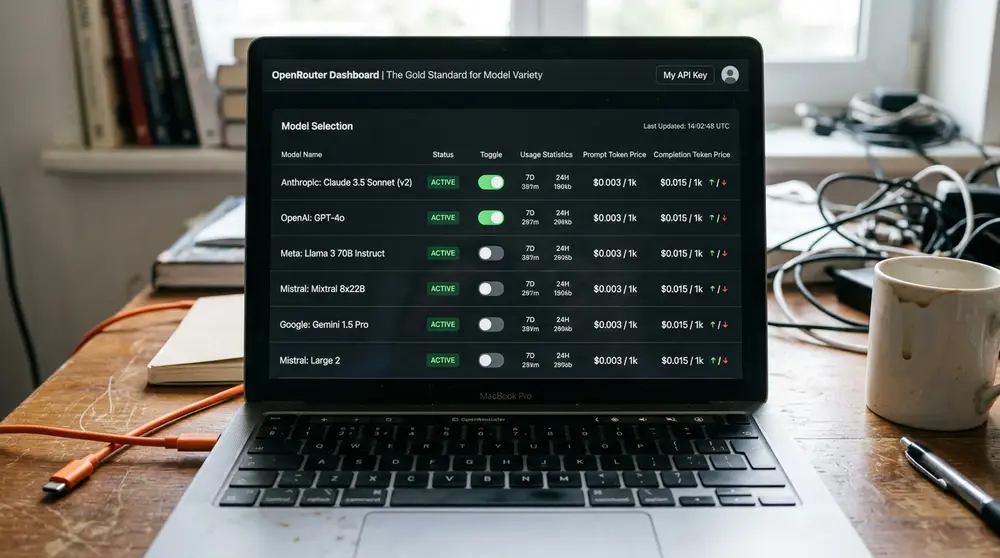
Their pricing is transparent and often lower than the providers themselves. They show you exactly what the latency and "top-p" settings look like for every model in real-time. I once saved 40% on a project just by switching from direct Llama usage to OpenRouter's hosted version of the same model.
The "Rankings" page on their site is a total sleeper hit. It shows you which models people are actually using for specific jobs. This helps you stop overpaying for a "famous" model when a cheaper, specialized one is doing a better job for everyone else.
2. Helicone: Precision Observability and Cost Control
Helicone
An essential observability platform that provides a microscope for your LLM usage and costs.
Helicone doesn't just give you an API; it gives you a microscope. It acts as an LLM observability platform that wraps around your existing providers to track every cent and every millisecond spent on a request.

I started using them after I realized I was paying for thousands of "zombie" requests from a buggy loop in my frontend code. Helicone caught it in minutes with a custom alert. They offer a "Gateway" feature that handles the unified routing, but their real value is the deep analytics dashboard.
You can see exactly which users are costing you the most and apply rate limits on the fly. For anyone scaling a SaaS, this level of control is mandatory to prevent a single power user from eating your entire profit margin for the month.
3. Portkey: Enterprise-Grade AI Gateway
Portkey
A robust, enterprise-ready gateway designed for teams that cannot afford downtime.
Portkey is built for teams that can't afford a single second of downtime. They offer an AI gateway that includes features like request retries, load balancing, and a specialized "Budget" routing system to keep you within a hard spending limit.

What surprised me about Portkey was their "Virtual Keys" system. You can give different departments or projects their own keys while managing the actual provider secrets in one secure vault. It’s much safer than pasting your actual Anthropic key into five different environments.
They also have a great prompt management tool. You can edit your prompts in their UI, test them across different models simultaneously, and deploy the change without touching your application code. This alone saves my team hours of deployment time every week.
4. LiteLLM: The Open-Source Python Powerhouse
LiteLLM
The ultimate open-source 'glue' for AI, perfect for local development and cost-conscious self-hosting.
If you prefer to keep everything in your own infrastructure, LiteLLM is the way to go. It’s a Python library (and a standalone proxy server) that lets you call 100+ LLMs using the OpenAI format. It’s effectively the "glue" of the AI world.

The first time I set this up, I was shocked at how lightweight it was. I ran the proxy on a tiny $5 DigitalOcean droplet and it handled all my routing perfectly. It’s perfect for developers who want the benefits of a unified API without paying a middleman fee.
It’s also the best tool for local development. You can point your app to a local Llama model via Ollama using LiteLLM, then switch to a production-grade GPT-4o endpoint just by changing an environment variable. No code changes required.
5. Martian: The Smart Router for Dynamic Cost Savings
Martian
A 'smart' router that uses model mapping to automatically find the most cost-effective path for every prompt.
Martian takes a different approach by focusing on "Model Mapping." Their router doesn't just pass requests; it analyzes the complexity of your prompt and sends it to the least expensive model capable of answering it correctly.
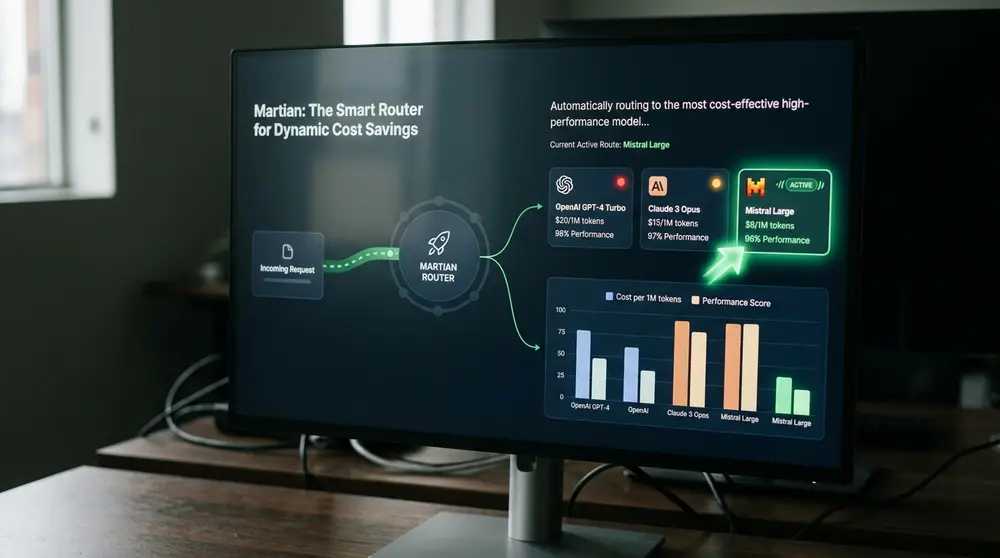
I tested this with a mix of hard logic puzzles and simple "Hello" messages. Martian sent the "Hello" to a sub-penny model and the puzzles to the high-end frontier models. My bill dropped by roughly 60% without any noticeable dip in the quality of the answers.
It feels a bit like magic because you stop thinking about "which model to use" and start thinking about "what quality level do I need." They handle the dirty work of benchmarking and switching, which is a massive relief when you're managing complex workflows.
6. Vercel AI SDK: Seamless Frontend Integration
Vercel AI SDK
The path of least resistance for web developers to integrate multi-model AI into their applications.
For web developers, the Vercel AI SDK is the path of least resistance. It’s not a standalone "provider" in the traditional sense, but it provides a unified interface for streaming responses from dozens of different LLMs directly into your UI.

I love how it handles the "edge" cases. You can stream a response from OpenAI and, if it fails, the SDK makes it incredibly easy to switch the stream to a backup like Google Gemini. It’s built to work perfectly with Next.js and other modern frameworks.
The cost savings here come from reduced development time and the ease of switching to cheaper "Edge" models. By moving the logic to the edge, you reduce latency and can often use smaller, cheaper models for UI-specific tasks like autocompletion.
7. GlueOps: Managed Infrastructure for Scale
GlueOps
A managed infrastructure solution for enterprises that prioritize security and reliability over minor cost differences.
GlueOps is geared toward larger organizations that need a "managed AI" experience. They focus on the boring but essential parts of the stack: reliability, security, and consistent uptime across multiple clouds.

When you're running a mission-critical service, you care less about saving $5 and more about making sure your AI doesn't break at 3 AM. GlueOps provides that peace of mind by managing the underlying infrastructure and providing a unified layer that resists provider outages.
Their reporting is particularly good for compliance. If you need to prove where your data is going and how much is being spent on specific client accounts, GlueOps makes that data very easy to export and audit.
8. One API: The Best Self-Hosted Multi-Channel Hub
One API is an open-source project that has gained a massive following for its ability to redistribute API credits. It’s a favorite for developers who want to build their own "AI SaaS" and need a way to manage hundreds of users' balances.
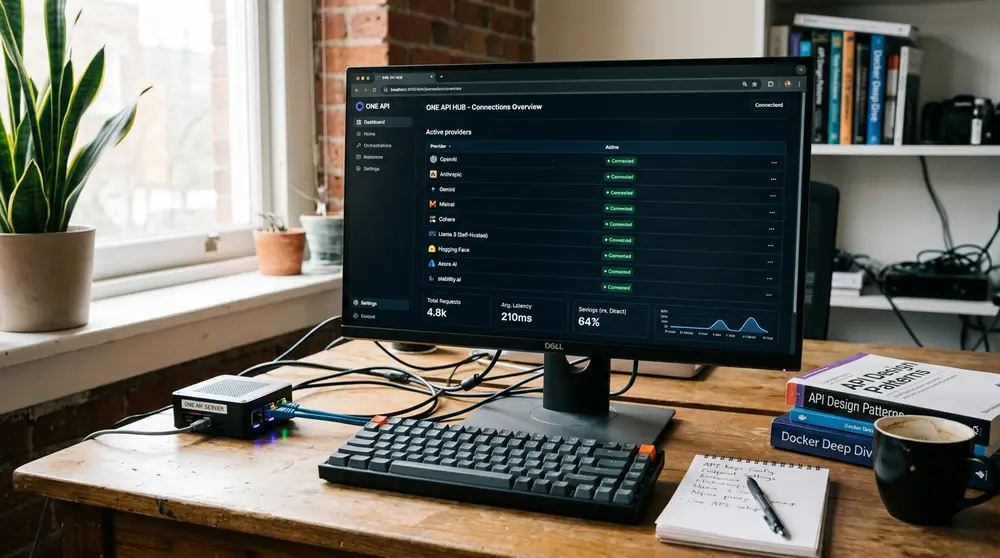
The interface is a bit more "utilitarian" than OpenRouter, but the power it gives you is unmatched. You can add "channels"—different API keys from different providers—and set priorities or weights for each. It’s the ultimate tool for DIY cost optimization.
I once used One API to build a small internal tool for a client. By pooling their various corporate API keys into one hub, we were able to see exactly which department was using the most tokens and bill them internally, which saved the IT department a massive headache.
9. AimPower: Performance-First Model Aggregation
AimPower differentiates itself by measuring "Intelligence per Dollar." They don't just look for the cheapest model; they look for the model that gives you the best results for the specific price point you've set.

They use a proprietary benchmarking system that updates constantly. Because model performance can actually drift over time (a phenomenon known as "model collapse"), AimPower keeps an eye on the output quality so you don't end up paying for a model that has secretly gotten "dumber."
This is a great choice if your work involves high-stakes data extraction or coding assistants. You get the discount of a unified provider with the added safety of an active quality control layer.
10. Neutrino AI: Intelligent Model Routing and Optimization
Neutrino AI is like having a senior AI engineer constantly monitoring your API calls. They use AI to route your prompts to the most efficient model, often cutting bills by more than half while actually improving the speed of your app.

Their "Neutrino Router" is their flagship product. In my experience, it’s particularly good at identifying when a prompt is simple enough for a "small" model (like Llama-3-8B) versus when it needs a "large" model (like GPT-4). It does this in milliseconds before the request is even sent.
The transparency is also top-notch. They provide a "Cost vs. Quality" slider in their dashboard. If you're running low on budget for the month, you can slide it toward "Cost," and the system will automatically prioritize the cheapest possible models that still meet a baseline quality level.
Comparing the Top Unified AI Providers at a Glance
Finding the right unified API means balancing cost, model access, and technical reliability. This comparison highlights how the industry leaders stack up against each other in the current market.
While OpenRouter dominates for sheer variety, tools like Martian focus on the bottom line by swapping models based on live pricing. If you are handling millions of tokens daily, even a 10% difference in routing efficiency can save thousands of dollars on your monthly cloud bill.
Evaluating Performance and Value
Most developers start with OpenRouter because it supports over 200 models with a single API key, but enterprise teams often lean toward Portkey for its observability stack. Portkey allows you to track latency and success rates across multiple providers, which is vital for maintaining uptime during provider outages.
For those who need total control over their data, LiteLLM offers a self-hosted proxy. This approach is popular with healthcare or fintech firms that cannot send raw logs to a third-party aggregator but still want the convenience of a unified OpenAI-style format.
| Provider | Model Variety | Key Strength | Estimated Savings |
|---|---|---|---|
| OpenRouter | 200+ Models | Direct model variety | Up to 50% |
| Portkey | 50+ Models | Enterprise reliability | Up to 40% |
| Martian | Smart Routing | Automatic cost optimization | Up to 70% |
| LiteLLM | 100+ Models | Open-source/Self-hosted | Varies (DIY) |
What should you look for in a cheap AI API provider?
Don't just chase the lowest price. A provider that saves you 70% but adds 2 seconds of latency to every request will kill your user experience. Always test the "time to first token" (TTFT) before committing your entire infrastructure to a new gateway.
Security is the other non-negotiable. Ensure the provider has a clear policy on data retention—you don't want your proprietary prompts being used to train someone else's model. Look for SOC2 compliance or "zero-retention" guarantees in their terms of service.
Check the "exit strategy" too. The best providers use the OpenAI-compatible format, which means if they ever go out of business or hike their prices, you can point your code to a different provider just by changing the base URL. Never lock yourself into a proprietary SDK that makes you a prisoner to one vendor's pricing.
The future of AI isn't one model to rule them all, but a thousand specialized models working together—and the unified API is the only way to manage that chaos without going broke.
Leave a comment